
Índice
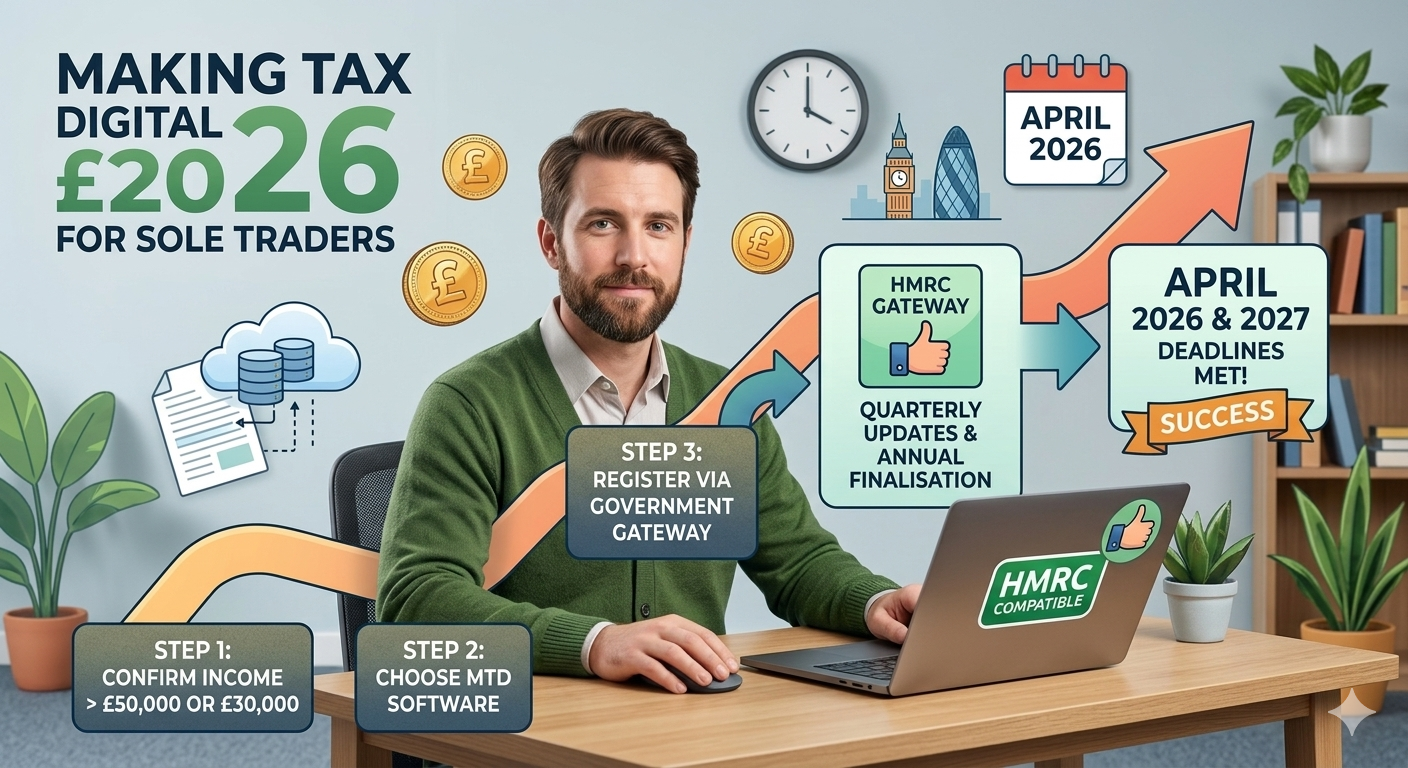
Making Tax Digital for Income Tax is no longer a distant tax change UK sole traders can ignore. If your qualifying income from self-employment and property was over £50,000 in the 2024 to 2025 tax year, HMRC says you will need to use it from 6 April 2026. If it was over £30,000 in the 2025 to 2026 tax year, your start date becomes 6 April 2027. The threshold is also set to widen again from 6 April 2028 for people over £20,000 in the 2026 to 2027 tax year.
That is the technical update.
The practical one is harsher.
If your bookkeeping is messy, your receipts are scattered, and your current “system” depends on panic in January, Making Tax Digital for Income Tax is not just another compliance tweak. It is the moment weak admin starts costing real time, real money, and real stress.
This is why waiting is a mistake. The businesses that adapt early will treat this as a manageable change. The ones that delay will turn it into an avoidable mess.
According toHMRC guidance on Making Tax Digital for Income Tax, sole traders and landlords above the qualifying income threshold will need to follow the new reporting process and keep digital records.
What Is Making Tax Digital for Income Tax?
At its core, Making Tax Digital for Income Tax changes how sole traders and landlords keep records and report to HMRC. Instead of treating tax as a once-a-year scramble, people in scope will need to keep digital records, send quarterly updates, and complete the year-end process through compatible software. HMRC’s step-by-step guidance also makes clear that HMRC does not provide its own software for this; taxpayers need software that works with the service.
That point matters more than it seems.
A lot of business owners still think the change is basically “filing online.” It is not. The real shift is operational. HMRC is moving people into a system that rewards clean records and punishes sloppy processes.
So the biggest question is not, “What is the rule?”
It is, “Is my workflow good enough to handle it?”
Who Needs to Use Making Tax Digital for Income Tax in 2026?
The first mandatory group starts on 6 April 2026. HMRC says this applies if your qualifying income from self-employment and property was over £50,000 in the 2024 to 2025 tax year. The next wave begins on 6 April 2027 for those above £30,000 in the 2025 to 2026 tax year.
That sounds simple, but this is where many people misread the situation.
They mix up turnover, profit, salary, household income, and qualifying income. Those are not the same thing. HMRC’s guidance is based on qualifying income from self-employment and property, so the safest move is to check your figures carefully instead of assuming you are below the line.
And one more mistake is very common: waiting for HMRC to tell you. HMRC says that if you need to use the service, you should be prepared and signed up before you need to start using it.
You can read the official Making Tax Digital for Income Tax introduction to understand who is affected, when the rules start, and what changes in practice.
Why So Many Sole Traders Are Underestimating This Change
Most small business owners are not struggling because they cannot understand a government rule. They struggle because their admin is already fragile.
That usually looks like this:
- expenses recorded late
- receipts buried in emails
- mixed personal and business spending
- inconsistent categories
- spreadsheets no one fully trusts
- no clear handoff between the owner and the accountant
Under the old routine, people could often get away with that until Self Assessment season. Under Making Tax Digital for Income Tax, those weaknesses show up faster because reporting becomes more regular and more dependent on digital recordkeeping. HMRC’s guidance makes clear that digital records and quarterly updates are central parts of the process.
That is why this topic is so valuable commercially. The reader is not casually browsing. They are looking for relief.
What Sole Traders Need to Do Before April 2026
The smartest move is not to obsess over the deadline first. It is to build a cleaner system before the deadline starts controlling you.
1. Check whether you are actually in scope
If your qualifying income from self-employment and property was over £50,000 in 2024 to 2025, HMRC says 6 April 2026 is your start point. If you are close to that line, check carefully instead of guessing.
2. Clean up your records now
If your records are already disorganised, software alone will not save you. Before comparing tools, fix the basics:
- separate business and personal spending
- categorise expenses properly
- make sure income records are complete
- stop relying on memory
3. Choose software that actually fits your business
HMRC says you need software that works with Making Tax Digital for Income Tax and that HMRC does not provide its own software. GOV.UK provides a software list and a tool to help taxpayers find software that meets their needs.
That means the real software question is not, “What is the cheapest option?”
It is, “What will make compliance easier every quarter?”
For most sole traders, good software should help with:
- digital recordkeeping
- quarterly updates
- expense tracking
- year-end reporting
- access for an accountant or bookkeeper when needed
Cheap tools that create more manual work usually become expensive later.
4. Decide who owns the process
You may choose to handle the reporting yourself. Alternatively, your accountant can take care of it. In some cases, a bookkeeper may maintain the records throughout the year.
That decision matters because the process is easier when roles are clear before the first reporting cycle begins.
5. Do not forget the crossover year
HMRC says you still need to submit your Self Assessment tax return for the tax year before you start using Making Tax Digital for Income Tax. So if you start using MTD from 6 April 2026, your 2025 to 2026 tax year still needs the normal Self Assessment route first.
That is exactly the kind of detail shallow articles tend to miss.
How Quarterly Updates Actually Change the Way You Work
Quarterly updates sound manageable when you read them on a GOV.UK page. They feel different when you run a business with inconsistent admin.
HMRC’s guidance says compatible software must support digital records and quarterly updates, and its developer guidance describes a reporting rhythm built around 4 quarterly updates plus the final declaration.
For a very simple business, that may be fine once the system is in place.
For someone with multiple income streams, rental income, irregular expenses, or weak bookkeeping habits, it creates more pressure. That is why the strongest preparation is not reading more articles. It is fixing the workflow.
In other words, Making Tax Digital for Income Tax is not only a tax change.
It is a business process change.
Penalties, Complacency, and the Wrong Way to Read the Rules
HMRC published updated guidance in March 2026 confirming that new late submission and late payment penalties apply from the tax year a person joins Making Tax Digital for Income Tax. HMRC also says the old penalties still apply to previous tax years.
There is one detail that may tempt people to relax too much: HMRC says that if you are required to use MTD from 6 April 2026, it will not apply penalty points for late quarterly updates in the first year, 2026 to 2027. But that does not mean there is no risk. HMRC also says penalties can still apply for late tax returns or late payment.
That distinction matters.
A lot of people will hear “first-year easing” and translate it into “I can leave this until later.” That is the wrong conclusion. You still need the records, the software, and the process. The absence of early penalty points on one part of the system is not the same as being prepared.
How to Choose the Right MTD-Compatible Software
This is where most articles become generic. They start listing tools without helping the reader think clearly.
The better approach is simpler.
Choose software based on how much friction it removes.
HMRC’s guidance says your software should support the income sources covered by MTD, allow you to send quarterly updates and submit your tax return, and work with your accounting period. GOV.UK also provides a list and search tool for compatible software.
That means the right tool is usually the one that helps you:
- keep digital records consistently
- reduce manual corrections
- see your income and expenses clearly
- stay on top of deadlines
- share clean data with an accountant
Price alone should not decide which tool you choose. Likewise, a highly reviewed platform is not always the best fit for your business. In practice, the right choice is the software you can use consistently every month without creating extra friction.
Before choosing a tool, review the list of compatible software for Making Tax Digital for Income Tax to compare which options support digital records, quarterly updates, and year-end reporting.
Waiting too long
This is still the biggest one. People delay because the date feels distant, then realise the admin work is bigger than expected.
Assuming quarterly updates replace everything
They do not. You still need to complete the year-end process properly.
Thinking software alone fixes weak bookkeeping
It helps, but it does not repair bad habits automatically.
Keeping business and personal spending mixed together
This makes recordkeeping harder than it needs to be and creates avoidable cleanup work later.
Treating MTD as just a compliance topic
It is compliance, but it is also workflow, visibility, and discipline.
That last point is where smart business owners gain an edge. They use the change to build a cleaner operating system for the business.
Final Checklist Before April 2026
If you want the short version, this is it:
Check whether your qualifying income puts you in scope for 6 April 2026.
Clean up your records before the new reporting cycle starts.
Choose software that works with Making Tax Digital for Income Tax and fits your actual workflow.
Decide whether you, your accountant, or your bookkeeper will manage the process.
Remember that the tax year before you join MTD still goes through the usual Self Assessment route.
Do not confuse first-year easing on some quarterly update penalties with full protection from problems.
And most importantly, stop treating tax as a once-a-year emergency.
That mindset is exactly what this system exposes.
Bottom Line
For many sole traders and landlords, Making Tax Digital for Income Tax is not really a story about technology. It is a story about whether your business is organised enough to report cleanly, consistently, and without last-minute panic.
If you are in scope for 6 April 2026, the smartest move is to act before the deadline starts dictating your workflow. Better records, better software, and a better routine will do more than help you comply.
They will make the business easier to run.
FAQ
Who needs to use Making Tax Digital for Income Tax from April 2026?
HMRC says sole traders and landlords with qualifying income from self-employment and property over £50,000 in the 2024 to 2025 tax year need to use it from 6 April 2026.
When does the £30,000 threshold start?
HMRC says taxpayers over £30,000 in the 2025 to 2026 tax year need to start from 6 April 2027.
Will the threshold fall again later?
Yes. The government has published that the threshold will extend to those over £20,000 from 6 April 2028.
Does HMRC provide free MTD software?
HMRC does not provide its own software. GOV.UK instead points users to compatible commercial options and a software finder tool.
Do quarterly updates replace year-end reporting?
No. HMRC’s guidance shows that quarterly updates are part of the process, but the year-end submission still matters.
Are penalties waived in the first year?
Not fully. HMRC says there will be no penalty points for late quarterly updates in the first year for those required to join from 6 April 2026, but penalties can still apply for late tax returns and late payment.
Business owners who expect to fall within the new rules should also check how to sign up for Making Tax Digital for Income Tax before the reporting cycle begins.